2026 Project
Million Dollar Vectors
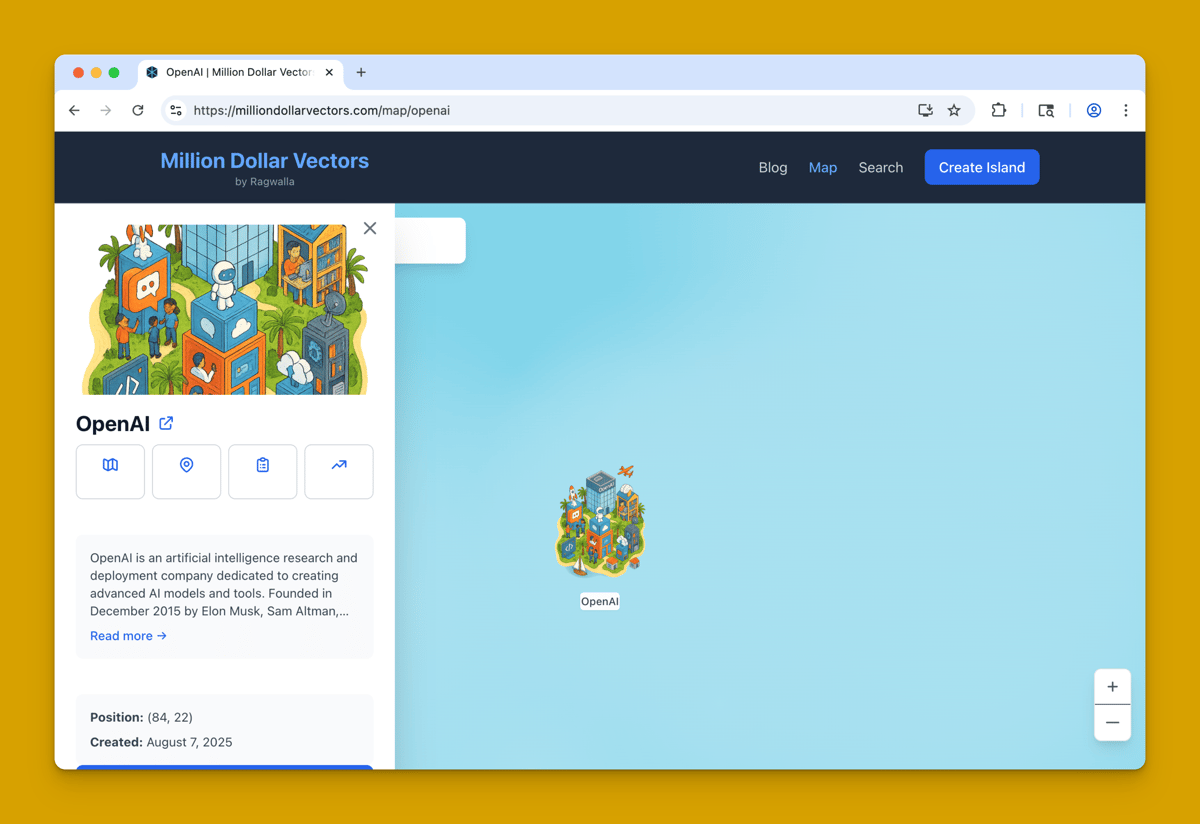
Million Dollar Vectors was born out of a simple but powerful curiosity: what would vector embeddings look like if we could actually see them?
Why Create MDV?
When working with AI models, one of the most intriguing outputs is the vector embedding—a high-dimensional numerical representation of text, images, or other content. These embeddings are where meaning lives: they capture relationships, similarities, and context in a way machines can understand.
But for all their power, embeddings are somewhat abstract. Numbers in a 1,536-dimensional space (like those from OpenAI’s models) don’t exactly lend themselves to human intuition. But I wanted to visualize them—to create something tangible, explorable, and even playful.
That desire led me down a path:
- Reduce embeddings from high-dimensional space into 2D.
- Place them on an interactive, Google Maps–style interface.
- Let people literally navigate meaning the way we navigate geography.
- Find semantic paths between content.
This experiment grew into MDV.
A Nod to the Past
The name Million Dollar Vectors pays homage to the Million Dollar Homepage from the early 2000s, where pixels were sold one at a time. In MDV’s case, we’re not selling pixels, but vector space—mapped and visualized in two dimensions. Each point, each cluster, is a tiny island of meaning in an ocean of ideas.
What Are Vector Embeddings?
Vector embeddings are numerical representations of data that capture semantic meaning in a way machines can understand. They're the foundation of modern AI systems, from search engines to recommendation systems.
Why They Matter
- Semantic Understanding: Vectors capture meaning, not just keywords
- Similarity Search: Find related content based on meaning
- Cross-Modal Applications: Connect text, images, and more
- Scalability: Efficient at massive scale